

- Urbanbees project
- Learn about bees
- Participate
- Download
- Contact
Working with the bees

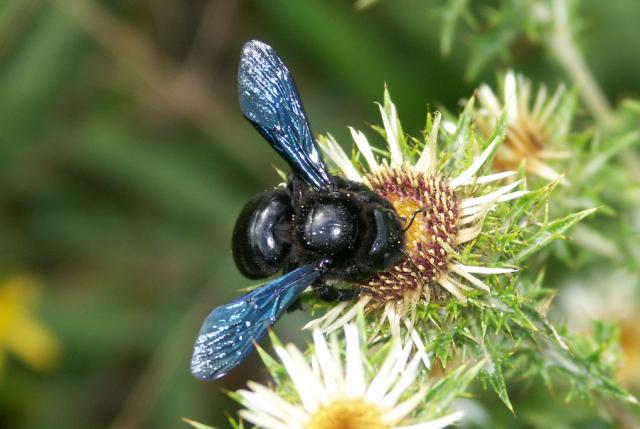
Bees (Apoidea Apiformis) are extremely diversified. There are almost 1000 wild species in France, as well as the honey bee raised by beekeepers (also known as the domestic bee). 2500 different species are known in Europe and close to 20 000 have been recorded throughout the world.
We found around 300 species in the four different types of environments given, and over the four years of data collection.
Special attention is paid to interaction between these bees with local flora (indigenous, exotic, cultivated), and also with habitat (building material and nesting sites).
Since little is known about wild bees in France, this part is essential to pin-point the methods and the approaches that should be carried out for restoration and conservation. Moreover, this work will help identify the food sources and resources available in urban and peri-urban spaces.
The protocole simplified
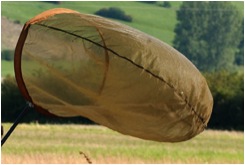
During four years, data is collected once a month, at each of the 24 sites. Data is recorded by INRA and Arthropologia members. Two methods are used, quantitative (colour-coded dishes) and qualitative (capture by net).
In 2012, special nets will be set up at the openings of nests in nesting walls and on the square of soils to capture specimens for data collection.
The bees are then prepared (mounted and labelled) for identification. Once they are divided into family and genre, they are either put into their species category on the field, or, sent to specialists of the genre in question, in other countries in Europe. During the four year study, we collected 18600 specimens in the four different environments.
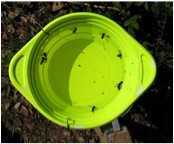
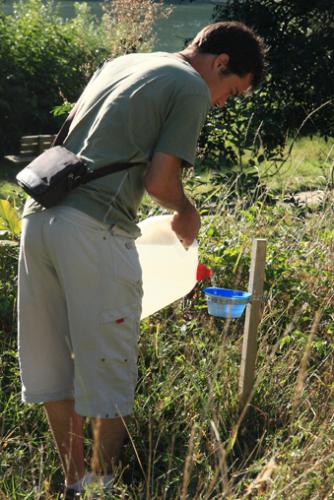
A method of data collection used in the protocol of the UrbanBees research
programme : a coloured dish filled with a mixture of water and detergent is left on the site for 24 hours.

